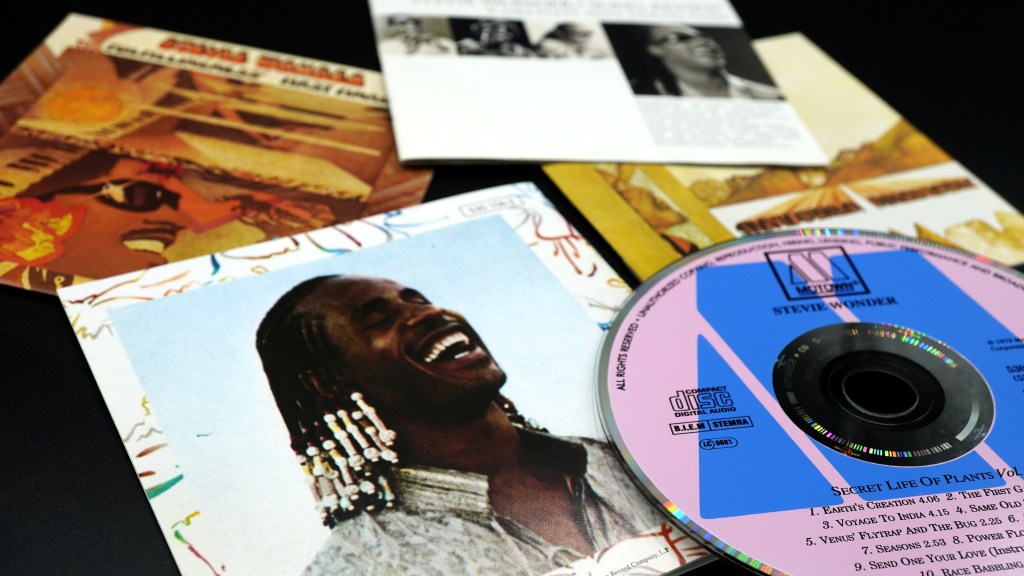
A personal essay on gripes with time and how Stevie Wonder inspires me to push through.
I have always found comfort in the idea that time is little more than a construct observed solely for organizational purposes. But to truly abide by this concept would be a luxury that I, unfortunately, have never felt as though I could afford.
I want nothing more than to go about my days with little regard for time, to complete tasks as I please rather than chaining myself to the construct of time.
Even now, as my inner voice dictates what words to type, my eyes glance back and forth to the clock in the upper right-hand corner of my laptop. I’ve given myself less than one hour to make my way substantially far into this entry, and it’s taken nearly ten minutes just to write this paragraph. I’ve messed with its formatting in the same way a child attempts to complete a puzzle. We both move piece by piece, aiming to successfully construct a depiction of life. Yet, our goals diverge because I am corrupted by time, paralyzed by its ability to pass me by as I fixate on singular words and types of punctuation and what tales take precedence over others.
Minutes, hours, days, months, and years– they wait for no one, unphased by inner-struggles and outward-toil. On one hand, this means that you can set your own pace. You can choose to ignore the construct and move in a way that aligns with your needs and capacities. But the agents of time will always be there to remind you that you’re just not there yet.
These sorts of nearly-existential spirals always lead me back to Stevie Wonder, not only for the comfort that his music evokes but because of his passage through time. It is dually inspiring and unnerving.
Born to Calvin Judkins and Lula Mae Hardaway in Saginaw, Michigan, Stevland Hardaway Judkins was a musical prodigy. Despite being born with retinopathy of prematurity, which led to blindness, he saw the world through music, playing a range of instruments from the piano to the harmonica.
He had his first number one hit at 13 with the 1963 single “Fingertips (Pt. 2)” under the stage name “Little Stevie Wonder,” which made him the youngest artist to ever obtain this title.
Little Stevie Wonder was almost booted from Motown Records after it was clear that he could no longer be marketed as “little.” Puberty changed the sound of his voice, and the label was unsure of how to move forward. However, it is thanks to Sylvia Moy– the first woman to hold the title of “record producer” at Motown– that he was able to stay on the label and continue making music as “Stevie Wonder.”
Between the ages of 23 and 26, he released Innervisions (1973), Fulfillingness’ First Finale (1974), and Songs in the Key of Life (1976), all of which won Grammy awards for Album of The Year. In fact, this run of albums made Stevie Wonder the only artist to ever win AOTY for three consecutive album releases. Realistically, though, there are no amount of accolades that could properly represent his wondrous talent.
The sounds and skills of Stevie Wonder only became more refined as time passed him by, allowing him to craft multiple masterpieces that function almost as a time capsule for the times at which they were released while still maintaining their novelty. He has been imitated, referenced, and sampled numerous times throughout history, but we’ve seen few artists reach that same caliber in the nearly 62 years since his debut.
One can’t exactly say that Stevie Wonder has moved through time with the utmost ease, but he found his footing, working alongside time rather than allowing it to be a constraint. With time, his career was propelled forward, and as he enters his 74th year, he remains one of the greatest to ever do it.
I’m often led back to his penmanship, his use of synths, and how he effortlessly moves through vocal scales, amazed at how much pure talent could exist within one person. But it is quite difficult to reckon with the idea that one has all of the time in the world to succeed when talents like Stevie Wonder exist. He amassed successes that modern-day artists can only dream of achieving, all before the age of 30.
Embed from Getty ImagesWhen I think of Stevie Wonder, I am inspired by his legacy while also wary of whether or not my own successes can be achieved so early on. I think of all the artists who got a taste of success in the early stages of their career and only became better with time. But I also think of those who, decades into their career, flip the script completely and are criticized as they chase new endeavors.
We appreciate artists in their prime, but as they get older, our expectations become skewed. It’s like they should change, but they shouldn’t stray too far from the original path, nor should they stay on any path for too long– once they reach a certain age, we expect them to stay in the shadows unless they can perform at the same caliber of their youth. And even if they do maintain the same energy and vocal ability, we still find ways to be angry. “If some of the most talented people to grace this planet can’t win, even after reaching the highest of heights, then how can I?” I sometimes wonder.
The idea that success must be achieved within one’s youth, or as close to it as possible, before vanishing with time seems to always be looming in the background.
We know, logically, that success is bound neither to time nor age, that breaking records and setting new standards can happen at 25, 46, or 63, so long as you put the work in and refine your craft. But time does not always feel the most kind to logical stances, nor is society the most kind to those unable to boast large successes in their youth. The dynamic is convoluted at best.
But my gripes with time, along with my deep-dives into the discographies of the greats like Stevie Wonder, have taught me that that time does not have to take full precedence over the direction of one’s life. That time only passes by when one chooses to stand still rather than move with it. That my own puzzle-like depictions of life and narratives and hopes and dreams can be handled with the patience of a child who is preoccupied with simply making it to the end of the puzzle rather than fixating on the amount of time it takes to construct it. That, like Stevie Wonder, I can lead with love and intention and innovation and the continual pursuit of brilliance– and that will get me where I want to be in spite of time’s grip.
I used to fear time, along with the idea that it would pass me by before I could truly achieve greatness. But Stevie Wonder’s music makes me feel as though time is the farthest thing from relevant, that talent is timeless and that you cannot truly live unless your conscience exists in the melodies of the present.
As he states on “Visions,” the second track off of Innervisions, “Today’s not yesterday, and all things have an ending,” So I embrace the successes, the downfalls, and all of the in-betweens experienced today, yesterday, and in all of the days to come. There’s no time for hypothetical failures to pervade the foreground of my mind when there are masterpieces to create, even if they won’t be the next Innervisions.


 The Rhyme Suite
Leave a comment