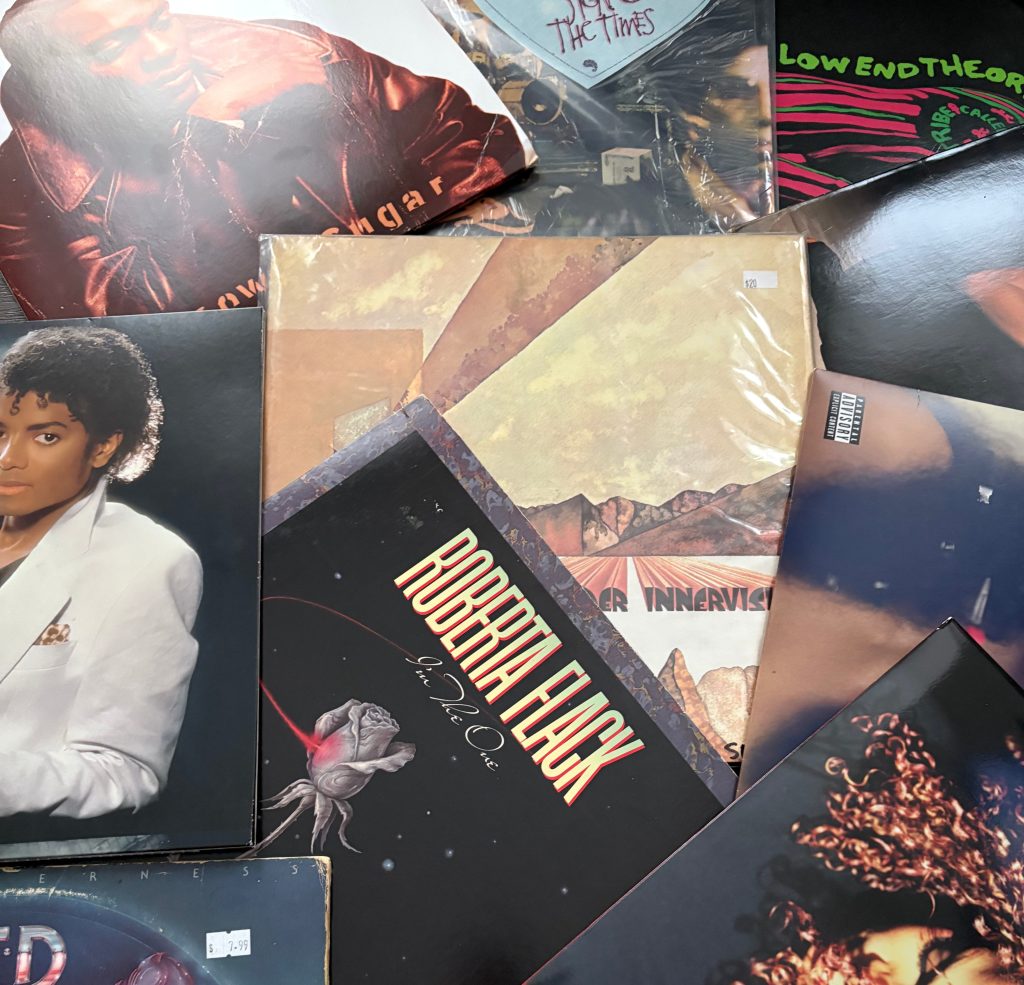
Why you should be investing in the art you love.
You would have thought it was my first time playing the record in full, but it was actually my second.
Weeks prior to this typical Thursday evening, I made a trip to my favorite record store— a mid-size joint filled with too many classics to count. With each visit, I find myself overwhelmed in the best way possible, as there is very little that stops me from walking out with half of the store. But during this particular trip, I struck gold with Anita Baker’s “The Songstress.”
Ms. Baker’s voice is as tantalizing as they come, which has made the inability to stream her full discography via Spotify quite frustrating. But that’s the thing with physical media— once you purchase a copy, it’s yours regardless of streaming rights, royalties, and the like.
I spun “The Songstress” a day or two after the initial purchase, but it wasn’t until weeks later on this particular evening that I really listened. I felt slightly ajar from the day’s festivities and in need of a healing sound. So I grabbed “The Songstress,” aware that “Angel,” the opening track, would calm my senses.
But the song and the project itself did more than that.
As I sat on my couch, I found myself enveloped in the sincerity of Ms. Baker’s voice. I wasn’t exactly on the verge of tears, but I could feel the intensity of every pent up emotion leaving my body. In the span of no more than two minutes, I was filled with pure bliss.
It’d be unreasonable to claim this is solely due to the fact that I was listening to these songs on vinyl, as I’ve had equally if not more emotional responses to songs that I listened to via digital means. But the ability to connect with the music and disconnect from my phone or laptop was crucial for the sake of a genuine wind-down.
I became a sort of vinyl addict toward the latter end of last year and I can truly say that it has been one of the most fulfilling things hobbies I could have picked up.
There is something to be said about listening to incredible music without the need for a middleman.
Streaming is convenient to the extent that a phone, a pair of headphones, and a disposable range of $5 to $13, can allow one to listen to nearly anything, anywhere.
Yet I find myself interrogating whether something can be convenient to a fault, especially in a time where self-autonomy seems to be encouraged less and less– Why think for yourself when there are a number of tools that can think for you?
Investing in physical media is not particularly convenient nor cheap, but it’s an investment nonetheless. And if you look in the right places, you might just find that it’s not always ridiculously expensive. Just days ago, I copped the “Shaft” soundtrack for one U.S. dollar– it costs more than that to breathe nowadays.
Even if you completely ignore the manner in which most artforms amass more value over time, there’s still a huge sense of ownership. The media which you have spent your hard-owned cash on is yours to keep, meaning you are not beholden to the whim of a corporation. Despite the decades-long warning that the internet is forever, entire projects and archives are continually erased, suppressed, or otherwise altered in digital spaces.
Physical media can technically be subject to some of the same alterations via reprint or recall, but that just opens the door for an opportunity to cop a rare gem, which is much more rewarding than scrolling endlessly on a streaming platform. These platforms undeniably play a huge role in the distribution and popularity of music. They also make it easy for fans to obtain and connect with the music. But it comes at a huge cost: the art of discovery.
Algorithms have become so good at their job that it becomes increasingly more difficult to discover something new. Instead, they serve remnants of the content that we already love, which makes us accustomed to existing solely within the confines of our personal tastes and comfort zones. Frankly, there’s no fun in that.
I’d be remiss to act as though my own music taste hasn’t been largely influenced by the ease of streaming, but I like to think that investing in physical media and facilitating your own sense of discovery makes life much more thrilling. Balance is key, and I find fulfillment in building up my playlists and my personal library of records.
Whether you’re flipping through records, CDs, cassette tapes, or DVDs, you are building a collection full of tangible snapshots of history. Not only can you savor these snapshots in the moment, but you can pass them down to future generations.
That’s much more powerful than simply pressing play.
Additionally, you’re ensuring that the artist you love is getting a much larger cut of that cash. Streaming pays artists literal pennies, with platforms like Spotify paying artists between $0.003 and $0.005 for every stream (this means you’d have to play one song 1000 times for an artist to make between three and five dollars).
The reality is, our decision-making capabilities are actively being chipped at with every iteration of a virtual assistant, as is our ability to think for ourselves.
Investing in physical media will not solve these multi-layered problems, but it certainly gives us a semblance of that control and autonomy back. More than that, it makes us just a little less susceptible to just accepting any old thing that is served to us– we become curators and consumers rather than simply existing as the latter.
Physical media seeks to save us all because it allows us to truly escape into the works that we love with little compromise, and it forces us to be just a little more intentional about what we consume.
It is truly worth every penny.


 The Rhyme Suite
Leave a comment