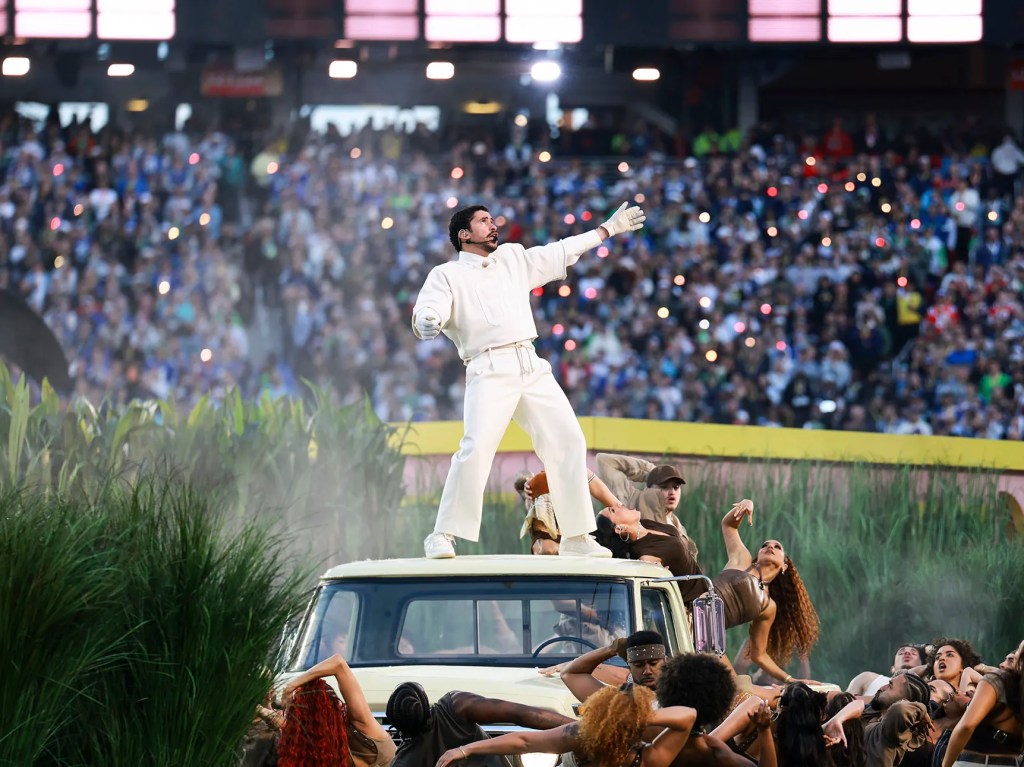
A deep dive into one of the most talked about Super Bowl performances.
The reactions to the prospect of Bad Bunny taking the Super Bowl LX stage for a halftime performance made me want to watch it even more.
As a casual fan of Benito myself, there would have already been an initial sense of excitement. Yet, when I saw folks calling for an “American” artist, I knew I’d have to tune in.
When stupidity presents itself on a silver platter, I won’t take a bite, but I will knock the platter out of a racist’s hands and laugh when they are reminded that Puerto Rico is, in fact, a part of the United States.
Nevertheless, I thoroughly enjoyed the performance.
Though I’m not fluent in Spanish, I recognized the importance of the moment and of doing the entire show in Spanish, with Lady Gaga’s cameo being the only English segment. I also recognized the importance of the imagery that he and Creative Director Harriet Cuddeford chose to enact. From showcasing sugar cane fields, to representing the island’s energy crisis, to tapping Ricky Martin – fellow PR superstar – to sing about how the colonization of Hawaii parallels what is happening in Puerto Rico. This show covered quite a bit of subject matter without feeling overwhelming. And more than that, it showed that you don’t have to compromise your beliefs to take on the world’s biggest stages.
But that’s the thing — is taking the stage of an exploitative, capitalistic organization not an inherent contradiction to revolutionary beliefs? Was Audre Lorde right in saying that you can’t dismantle the master’s house with the master’s tools, even if you know how to hit the right notes?
The short answer is yes, but at this point in America’s history, a simple yes or no feels inadequate.
Alex Skoppic of Current Affairs referred to the National Football League (NFL) as an “abusive workplace,” one that disregards players’ pleas for safer fields and gives them less time to recover from intensive games, games that often lead to serious head injuries and trauma. Not to mention the fact that the league profits off the backs of its predominantly Black players while also punishing them for speaking out, or kneeling down, against racial injustice. Steve Almond of WBUR even referred to the NFL as a “billion dollar plantation,” stating that the league is not only racially segregated but previously engaged in “race norming,” a practice that assumes African-American players have reduced cognitive abilities, which made it difficult for them to receive payouts for brain injuries that they might have received during their tenure. This practice was only suspended in 2021.
No amount of performances from Bad Bunny, Kendrick Lamar, Usher, or Rihanna erase these facts, even when these legendary artists are handpicked by Jay-Z and ROC Nation.
Revolution rears its head in many ways, and the fact of the matter is, the Super Bowl will never be the stage for revolution. But that doesn’t necessarily mean that this stage has no significance whatsoever.
We are perpetually kept in a state of fear and distress, all wrapped in a bow of uncertainty. Mis-and-disinformation via AI, embellishments, and straight up lies from our leaders make this even worse. It’s hard to have hope nowadays unless you completely disengage from what’s happening in the world, and frankly, this isn’t a viable option either.
With that in mind, it is important to acknowledge the role that media, entertainment, and entertainers play in inspiring people to take action. Music has always been used as a tool of revolution and protest, inspiring listeners to show up for their communities and stand up in the face of oppressive systems.
The capacity of these mediums to inspire change are a large part of the reason why the powers that be try so hard to influence us through them. And to be fair, that is also why I could understand how some people would interpret performances like Bad Bunny’s as a tool of the oppressor, a distraction from what is going on in this country so that people can cling to the notion of progress when, in reality, inclusivity can only take us so far when the folks being included are still facing persecution.
Yet, I would argue that “propaganda” only does half the work of disarming an individual who is already complacent. With all of the propaganda that Americans are essentially fed from birth, a Super Bowl performance can only be so effective. Someone who is politically disengaged and easily swayed by superficial gestures was always going to be impressed by Bad Bunny’s performance. They might have even walked away feeling as though it marked the potential for change and unity in an increasingly divisive nation. Confirmation bias is a real thing. We are susceptible to interpreting things, whether it be art or not, as confirmation of our own inherent beliefs. And sure, these beliefs can certainly be influenced by outer parties, but a change in one’s mindset, beliefs, and values are sort of intrinsic to the entire human experience – and it also requires much more than a 12 minute performance.
Bad Bunny’s performance is only as revolutionary as someone’s capacity to recognize revolution, and it is only as propagandistic as someone’s capacity to recognize propaganda.
We are constantly reckoning with the beauty, functionality, and hope that are likely the byproduct of some of the most oppressive institutions known to man. The irony is unavoidable, and it all comes down to what people choose to do with what little power they might have.
Maybe it would have been a bigger statement for Bad Bunny to decline performing at the Super Bowl, but maybe his decision to use that platform to spread a positive message is not the worst thing he could have done.
Maybe it is impossible for him or any other artist to start a revolution on the Super Bowl stage, but maybe we don’t need the people we idolize to do that for us. Maybe it is up to us to recognize that there is always more to be done, while also allowing ourselves to enjoy the tiny glimpses of joy and hope that might present themselves every now and then.
Maybe it was just a performance, maybe it was a gimmick. But maybe multiple things can be true at once. Maybe it is more about us and how we choose to show up for one another and fight for our rights and our humanity, regardless of what the machine may try to feed us.
The power is not only in the hands of those who hold the money or the microphone. It is in our hands, too.
 The Rhyme Suite
Leave a comment